In this post i gonna talk on how to troubleshoot an a/c problem in car. Many of us will not regularly service our car a/c like what we did on our engine. This is because car manufacturer rarely push to buyer and car owner about the importances to keep a good a/c system as to prevent unwanted break down of a/c. Of cause if compare an a/c to an engine, sure the engine is most important. But as a car owner, who does not want the car to be in good condition the whole time? So we must improve our self to know how to keep a good running car, so that the car does not fail us on the most importance day in our life.
So, the basic of a/c i was talking on my blog, i have gone through all the parts which is used in our car a/c. So if some parts or a part is failing, it will cause problem, then the a/c will not produce nice cold air as it should. Went into a/c shop, we will depend on the technician to tell us what is causing the problem.
Most of car owner is not aware that the detail the technician give is correct or not. They just simply say: ok, just do what you should do.. Then the nightmare begin...A proper done job on car a/c will save a lot of money and time in the long term. But a poorly done job.....It will not only cost you a lot of time, it will also burn a hole through your wallet. Trust me when i say a hole in the wallet.
Then, how should one troubleshoot an a/c problem? Ask your self this question first before making any move:
For new car less than 4 years:
1. Have you done your a/c service?
2. Have you change air con cabin air filter?
For old car more than 4 years:
1. When is the last time you service the a/c?
2. How long have it been after the last a/c service?
3. Have you change air con cabin air filter?
4. Have you change filter drier on last service?
This question need to be ask first, because many a/c problem is cause by a dirty cabin air filter, dirty evaporator, dirty filter drier and dirty condenser. When the cabin air filter and evaporator is dirty, the refrigerant inside evaporator will not have enough contact with the hot air outside evaporator, then the hot air cannot efficiently transfer the heat to the refrigerant (see my post on How does it work).
A dirty filter drier will cause the refrigerant flow be restricted. This will cause a weak flow of liquid state refrigerant into the evaporator. When this happen, there will be not enough refrigerant flow to take away the heat of the hot air around evaporator. Dirty condenser will cause poor effectiveness of the refrigerant to transfer heat to surrounding air before flow into evaporator. A high energy(heat) refrigerant will only be able to carry little energy from the hot air inside cabin thus the air will not be cooled enough.
This kind of problem can be easily solve by having a full a/c cleaning done on evaporator and condenser with new cabin air filter and also new filter drier changed. With a proper cleaning on evaporator and condenser as well as a proper level of refrigerant recharge back into system, the problem of not producing cold air should be okay in at least 2-3 years.
This is part 1 of this post. I will talk bout other problem in second post. Stay tune for more.
Showing posts with label auto a/c. Show all posts
Showing posts with label auto a/c. Show all posts
Tuesday, October 18, 2016

Wednesday, October 12, 2016
How does it work?
How does a/c work actually? Well it work by the mean of heat transfer by utilizing heat radiation transfer theory. In real life, the heat is a source of energy that cannot be seen, but can be feel. This is because heat is a form of radiation energy which we will need a special tool to see it (heat scanner).
Now, how does the a/c work? Easiest way to say, the heat is been absorbed by the evaporator and then it is release to the outside using a condenser. This is the simplest way of explaining. If want to know further detail, then bear with me..

See the number 1 and 2, it show how the surrounding air is being heated and then is cooled
A/C system is a closed system which contain refrigerant as a medium to transfer energy. Heat is a form of energy that can be transfered from one place to another using a radiation wave movement. In a/c, when the refrigerant is been pressurized in compressor, it contain so much energy thus make it hot(heat) to touch. This hot refrigerant then need to transfer its energy to the surrounding when it enter the condenser.

Condenser capture the energy(heat) from refrigerant and then release the energy(heat) by transferring the energy to the surrounding low energy air(lower temperature air). The fan in front the condenser push the surrounding low energy air so that the air can move faster entering and exiting the condenser. The energy in the condenser will travel to surrounding low energy air thus making the air more energize and hot while refrigerant will have less energy and cool down. The refrigerant that is now less energize will become low heat, high pressure liquid and went out from the condenser. At this state, the energy carried by the refrigerant is lower than the surrounding air, as the refrigerant is under high pressure, it will still feel warm to touch even tough the energy(heat) it carry is lower compare to surrounding air.
So the now low energy high pressure liquid state refrigerant will move on to evaporator. Before going into the evaporator, this high pressure, low energy liquid refrigerant will need to undergo depressurization at Expansion Valve first, so that it will enter the evaporator as a low pressure, low energy liquid refrigerant. This i will have future post to talk bout this Expansion Valve. Now i will focus how does a/c work.

This low pressure, low energy refrigerant will capture the energy in the surrounding high energy air while inside the evaporator. The energy in the surrounding air will travel to the refrigerant and release its energy to the low energy refrigerant. This will make the air leave the evaporator as a low energy(cold) air, and refrigerant will become energized and boil into vapor/gas and leave the evaporator.
So it is clear to see, in a/c system, the refrigerant play an important part as it is the only medium for the energy inside the surrounding air to travel to. Thats why when an a/c system is low on refrigerant, the cooling efficiency will drop. But in an a/c system, there is much more things that will cause the cooling efficiency to drop aside from refrigerant alone. I will talk more in my future post.
Now, how does the a/c work? Easiest way to say, the heat is been absorbed by the evaporator and then it is release to the outside using a condenser. This is the simplest way of explaining. If want to know further detail, then bear with me..

See the number 1 and 2, it show how the surrounding air is being heated and then is cooled
A/C system is a closed system which contain refrigerant as a medium to transfer energy. Heat is a form of energy that can be transfered from one place to another using a radiation wave movement. In a/c, when the refrigerant is been pressurized in compressor, it contain so much energy thus make it hot(heat) to touch. This hot refrigerant then need to transfer its energy to the surrounding when it enter the condenser.

Condenser capture the energy(heat) from refrigerant and then release the energy(heat) by transferring the energy to the surrounding low energy air(lower temperature air). The fan in front the condenser push the surrounding low energy air so that the air can move faster entering and exiting the condenser. The energy in the condenser will travel to surrounding low energy air thus making the air more energize and hot while refrigerant will have less energy and cool down. The refrigerant that is now less energize will become low heat, high pressure liquid and went out from the condenser. At this state, the energy carried by the refrigerant is lower than the surrounding air, as the refrigerant is under high pressure, it will still feel warm to touch even tough the energy(heat) it carry is lower compare to surrounding air.
So the now low energy high pressure liquid state refrigerant will move on to evaporator. Before going into the evaporator, this high pressure, low energy liquid refrigerant will need to undergo depressurization at Expansion Valve first, so that it will enter the evaporator as a low pressure, low energy liquid refrigerant. This i will have future post to talk bout this Expansion Valve. Now i will focus how does a/c work.

This low pressure, low energy refrigerant will capture the energy in the surrounding high energy air while inside the evaporator. The energy in the surrounding air will travel to the refrigerant and release its energy to the low energy refrigerant. This will make the air leave the evaporator as a low energy(cold) air, and refrigerant will become energized and boil into vapor/gas and leave the evaporator.
So it is clear to see, in a/c system, the refrigerant play an important part as it is the only medium for the energy inside the surrounding air to travel to. Thats why when an a/c system is low on refrigerant, the cooling efficiency will drop. But in an a/c system, there is much more things that will cause the cooling efficiency to drop aside from refrigerant alone. I will talk more in my future post.
Thursday, October 6, 2016
Charge refrigerant in gas or liquid?
Today topic will be on refrigerant recharge/refill in gas or liquid state. Many car a/c technician will come into this kind of question whether or not the refrigerant should be fill in gas state or liquid state.


There is 2 types of refrigerant already used in car industries, R12 and R134. R12 is banned in 1996 due to the effect it have on our earth ozone layer.
So for starter, refrigerant while still inside can, its continuously appear in gas and liquid form. The liquid will be in bottom of the can while the gas will be aboves the can. The nature of refrigerant which appear in gas and liquid form at the same time is because of the chemical properties the refrigerant have. So the great question begins, should the refrigerant fill in gas state? of liquid state?
This question depends on the charging port location in the car. While the high side port is always far away from the compressor, the low side port is the main factor to the question. Far away the low side port is from the compressor, the safer it is to charge refrigerant in liquid form. This is because, refrigerant in liquid form will carry compressor oil easily, while in gas form, it did not carry the oil.
Farther is the low side port from the compressor will make the refrigerant in liquid form have the time to expand into gas before it reach the compressor. While charging refrigerant, we did not want the compressor oil to directly carry away from the compressor by the refrigerant. Compressor oil is essential to compressor for lubrication, if the oil is carry away from the compressor and leave just a little inside, then the damage already been done after the oil return again to compressor.
This concept is suitable for charging while engine is off or running, because the liquid refrigerant will merge with the compressor oil and moving along when the compressor is working. So charging in gas state is the safest method although it will take a longer time to reach the full amount of refrigerant required by the a/c system.


There is 2 types of refrigerant already used in car industries, R12 and R134. R12 is banned in 1996 due to the effect it have on our earth ozone layer.
So for starter, refrigerant while still inside can, its continuously appear in gas and liquid form. The liquid will be in bottom of the can while the gas will be aboves the can. The nature of refrigerant which appear in gas and liquid form at the same time is because of the chemical properties the refrigerant have. So the great question begins, should the refrigerant fill in gas state? of liquid state?
This question depends on the charging port location in the car. While the high side port is always far away from the compressor, the low side port is the main factor to the question. Far away the low side port is from the compressor, the safer it is to charge refrigerant in liquid form. This is because, refrigerant in liquid form will carry compressor oil easily, while in gas form, it did not carry the oil.
Farther is the low side port from the compressor will make the refrigerant in liquid form have the time to expand into gas before it reach the compressor. While charging refrigerant, we did not want the compressor oil to directly carry away from the compressor by the refrigerant. Compressor oil is essential to compressor for lubrication, if the oil is carry away from the compressor and leave just a little inside, then the damage already been done after the oil return again to compressor.
This concept is suitable for charging while engine is off or running, because the liquid refrigerant will merge with the compressor oil and moving along when the compressor is working. So charging in gas state is the safest method although it will take a longer time to reach the full amount of refrigerant required by the a/c system.
Friday, September 30, 2016
Simple basic about Automotive A/C - Part 4
Well here comes part 4 of the basic a/c understanding. Here i gonna talk about Expansion valve, Evaporator, and Ventilating Blower (which can also called as Blower in short).


Currently there is 2 kind of Expansion valve that can be found in car a/c, both work in same principle.
Before refrigerant go into the evaporator, it will travel through filter drier, then arrive at expansion valve. In this stage, the refrigerant is in its liquid state, and it will feel warm to touch and is very high in pressure. Here is where the magic happen. The expansion valve will convert this high pressure liquid refrigerant into low pressure refrigerant. The lost in pressure of refrigerant will convert the refrigerant from warm to cold immediately.
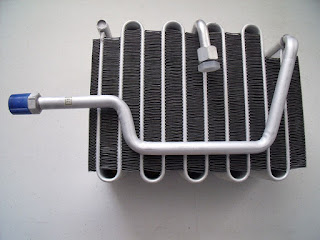

Evaporator comes in different pipe arrangement and shape. The left is Serpentine type, while right is Parallel type.
This cold low pressure refrigerant will then enter into Evaporator and it rapidly cool down the evaporator which make the evaporator colder than the surrounding air. The Blower will then blow the hot and humid surrounding air through the evaporator where the hot air will be convert into cold dry air and leave the evaporator. This cold air is what we feel at the ventilating in our car.


Picture at left is how the Evaporator work, and right is what Blower looks like.
The low pressure cold liquid refrigerant will be convert into its gases state while travel inside the evaporator. This low pressure gases refrigerant will be suck back into compressor and the whole process begin again in continuous loop.
So this is all the basic we need to know about automotive air condition. I may have rush to explain this in simple, because many parts cannot be explain in this 4 parts of posts. I will post each of the parts related in their dedicated post. In there i will further explain in detail.
Stay tune for more understanding of our car a/c system.


Currently there is 2 kind of Expansion valve that can be found in car a/c, both work in same principle.
Before refrigerant go into the evaporator, it will travel through filter drier, then arrive at expansion valve. In this stage, the refrigerant is in its liquid state, and it will feel warm to touch and is very high in pressure. Here is where the magic happen. The expansion valve will convert this high pressure liquid refrigerant into low pressure refrigerant. The lost in pressure of refrigerant will convert the refrigerant from warm to cold immediately.


Evaporator comes in different pipe arrangement and shape. The left is Serpentine type, while right is Parallel type.
This cold low pressure refrigerant will then enter into Evaporator and it rapidly cool down the evaporator which make the evaporator colder than the surrounding air. The Blower will then blow the hot and humid surrounding air through the evaporator where the hot air will be convert into cold dry air and leave the evaporator. This cold air is what we feel at the ventilating in our car.


Picture at left is how the Evaporator work, and right is what Blower looks like.
The low pressure cold liquid refrigerant will be convert into its gases state while travel inside the evaporator. This low pressure gases refrigerant will be suck back into compressor and the whole process begin again in continuous loop.
So this is all the basic we need to know about automotive air condition. I may have rush to explain this in simple, because many parts cannot be explain in this 4 parts of posts. I will post each of the parts related in their dedicated post. In there i will further explain in detail.
Stay tune for more understanding of our car a/c system.
Monday, September 26, 2016
Simple basic about Automotive A/C - Part 3
Welcome back to this part 3 of basic a/c. On last 2 post, i have talk about compressor, clutch, condenser, and condenser fan. So in this post, i will talk Pressure Switch, Service Port, and Filter drier.


This is A/C Pressure Switch used in car a/c. This switch comes in different design and shape, but all with same principle.
So, the pressure switch is use in a/c to take reading of refrigerant pressure inside the a/c system. It is use to regulate of how much pressure the system can take, and if the pressure is below or higher than the system can take, then the system will shut off the compressor to prevent major parts failure. This switch usually is placed at High Side of the a/c system, depends on system design, some car will come with two switch, one in Low Side, and one in High side.


This are the several kind of Filter Drier that can be found in cars. Deepening on system design, the filter will have different shape.
Filter Drier is use in a/c as an humid absorbent. This filter contain desiccant that can absorb small amount of water/vapor that may get into the a/c system during installation and service. A/C system required a dry condition for it to function properly. If there is too much water/vapor inside the system, the refrigerant will freeze up and thus blocking of refrigerant flow will happen.


Some of the service port that can be found in car a/c.
Service Port is use by a/c technician to plug a pressure meter to take reading of the internal refrigerant pressure. This port is very vital because it provide access to top up, recharge and also to recover the refrigerant in any a/c service.
This three parts will have its dedicated post in future. Now i will just focus on basic understanding of the car a/c.Stay tune for my last part.


This is A/C Pressure Switch used in car a/c. This switch comes in different design and shape, but all with same principle.
So, the pressure switch is use in a/c to take reading of refrigerant pressure inside the a/c system. It is use to regulate of how much pressure the system can take, and if the pressure is below or higher than the system can take, then the system will shut off the compressor to prevent major parts failure. This switch usually is placed at High Side of the a/c system, depends on system design, some car will come with two switch, one in Low Side, and one in High side.


This are the several kind of Filter Drier that can be found in cars. Deepening on system design, the filter will have different shape.
Filter Drier is use in a/c as an humid absorbent. This filter contain desiccant that can absorb small amount of water/vapor that may get into the a/c system during installation and service. A/C system required a dry condition for it to function properly. If there is too much water/vapor inside the system, the refrigerant will freeze up and thus blocking of refrigerant flow will happen.


Some of the service port that can be found in car a/c.
Service Port is use by a/c technician to plug a pressure meter to take reading of the internal refrigerant pressure. This port is very vital because it provide access to top up, recharge and also to recover the refrigerant in any a/c service.
This three parts will have its dedicated post in future. Now i will just focus on basic understanding of the car a/c.Stay tune for my last part.
Tuesday, September 20, 2016
Simple basic about Automotive A/C - Part 2
This is part 2 of the basic for automotive air condition. In last post, i have talk bout Compressor and Compressor Clutch. So in this post, i will explain the use of Condenser and Condenser Fan.
After the compressor pump the refrigerant out from the compressor, the refrigerant will be very hot and is in gases state. This hot gases will then be pushed to condenser to cool down its heat so that it can be used to generate cold air.


On the left is Condenser and the right is Condenser fan (can also called as Cooling Fan)
Condenser as the name suggest, is use to cool the hot refrigerant through the mean of heat transfer. The hot gases refrigerant contain so much heat when it leave compressor, it will be gradually cool when it travel in the condenser fin.
The heat will be transfer to the surrounding air around the condenser using a condenser fan (can also called cooling fan). The fan will push the surrounding air so that the air travel through the condenser and carry the heat away from the condenser when the air leave the condenser. This will cool down the condenser and in the same time cool down the refrigerant inside the condenser.

Picture show how the heat leave the condenser
The hot gases refrigerant will be cool down and become warm liquid refrigerant when it leave the condenser. This liquid refrigerant will be use to produce cold air when it reach Evaporator.
Stay tune for my next part.
After the compressor pump the refrigerant out from the compressor, the refrigerant will be very hot and is in gases state. This hot gases will then be pushed to condenser to cool down its heat so that it can be used to generate cold air.


On the left is Condenser and the right is Condenser fan (can also called as Cooling Fan)
Condenser as the name suggest, is use to cool the hot refrigerant through the mean of heat transfer. The hot gases refrigerant contain so much heat when it leave compressor, it will be gradually cool when it travel in the condenser fin.
The heat will be transfer to the surrounding air around the condenser using a condenser fan (can also called cooling fan). The fan will push the surrounding air so that the air travel through the condenser and carry the heat away from the condenser when the air leave the condenser. This will cool down the condenser and in the same time cool down the refrigerant inside the condenser.

Picture show how the heat leave the condenser
The hot gases refrigerant will be cool down and become warm liquid refrigerant when it leave the condenser. This liquid refrigerant will be use to produce cold air when it reach Evaporator.
Stay tune for my next part.
Thursday, September 15, 2016
Simple basic about Automotive A/C - Part 1
This is my first posts for my dedicated blog made just for automotive air conditioner. I mean to share my knowledge, how to diagnose and solves all problem related to air condition in our cars. In Malaysia, all of us that have owned a car is basically not know so much about our cars' a/c system, how to go around problem and how to solve the problem. So i will share my knowing on car a/c so that we can learn how to troubleshoot when problem arise in our cars' a/c system.
So in this blog, i will share a basic about our automotive a/c, which i will make it simple to understand. All of the picture i use in here is taken from Google Picture, so i do not hold copyright to all those pictures, neither do i do any alternation to the picture (unless state otherwise) and all can freely use as it is.

This is a simple diagram showing components which got in our car a/c. And the first i want to explain is Compressor. Compressor is a "heart" of the a/c in all kind of air conditioner found around this globe. If the "heart" fail, the a/c system will stop function, and end of story. But my story will not end here XD.
The function of the compressor is to circulate refrigerant from condenser to evaporator. Its work just like our body heart which pump our blood throughout our body, in air condition, this "heart" is pumping refrigerant throughout the a/c system.


This is a sample of compressor, the left side have a pulley "Multi Groove (can also called PK Groove)" and the right side pulley is "Wedge Groove (can also called V-Belt Groove)".
For the compressor to work, it required a moving parts to move the rotary shaft using what is know as compressor clutch. This clutch is attach to rotary shaft of the compressor.

Picture shown is Magnet Clutch Set, which consists of Pulley in the middle, a Clutch at bottom left, and a Magnet Coil of bottom right.
The pulley is attach to the body of the compressor, while the magnet coil is located behind the pulley, also attach to the body of the compressor, and the clutch is in front of the pulley. All three of this parts do not make contact to each other. The pulley will move along with car's main pulley driven by either using a V-Belt or a Multi-Groove belt. The magnet coil and the clutch will not move along with the pulley. The magnet coil will need to be magnetize first just then it will "Pull" the clutch to the pulley. When this happen, the clutch will stick to the pulley and it will move along with the pulley. While this happen, the clutch will drive rotary shaft of the compressor and thus make the compressor work.
This is Part 1 of this basic a/c explanation, stay tune for Part 2.
So in this blog, i will share a basic about our automotive a/c, which i will make it simple to understand. All of the picture i use in here is taken from Google Picture, so i do not hold copyright to all those pictures, neither do i do any alternation to the picture (unless state otherwise) and all can freely use as it is.

This is a simple diagram showing components which got in our car a/c. And the first i want to explain is Compressor. Compressor is a "heart" of the a/c in all kind of air conditioner found around this globe. If the "heart" fail, the a/c system will stop function, and end of story. But my story will not end here XD.
The function of the compressor is to circulate refrigerant from condenser to evaporator. Its work just like our body heart which pump our blood throughout our body, in air condition, this "heart" is pumping refrigerant throughout the a/c system.


This is a sample of compressor, the left side have a pulley "Multi Groove (can also called PK Groove)" and the right side pulley is "Wedge Groove (can also called V-Belt Groove)".
For the compressor to work, it required a moving parts to move the rotary shaft using what is know as compressor clutch. This clutch is attach to rotary shaft of the compressor.

Picture shown is Magnet Clutch Set, which consists of Pulley in the middle, a Clutch at bottom left, and a Magnet Coil of bottom right.
The pulley is attach to the body of the compressor, while the magnet coil is located behind the pulley, also attach to the body of the compressor, and the clutch is in front of the pulley. All three of this parts do not make contact to each other. The pulley will move along with car's main pulley driven by either using a V-Belt or a Multi-Groove belt. The magnet coil and the clutch will not move along with the pulley. The magnet coil will need to be magnetize first just then it will "Pull" the clutch to the pulley. When this happen, the clutch will stick to the pulley and it will move along with the pulley. While this happen, the clutch will drive rotary shaft of the compressor and thus make the compressor work.
This is Part 1 of this basic a/c explanation, stay tune for Part 2.
Subscribe to:
Posts (Atom)